Does Liability Coverage Cover When I Hit a Deer American Family
A recent article published by Joshua Kurlantzick in the Council of Foreign Relations dissects what he describes as the declining public image of Prc. At first glance, he isn't wrong. Over the past two years, positive stance of Cathay has indeed collapsed in Western and US-aligned countries. But the reasons he states for why that has happened are every bit disingenuous as they are outright false. The piece goes off on a tirade listing all the ways he thinks Prc is bad. From Covid-19, to and then-chosen "wolf warrior diplomacy," to the Chugalug & Road Initiative (BRI) "being a debt-trap," to "aggressive and coercive beliefs," to Chinese vaccines manifestly existence "ineffective" and so on.
What is curious almost these reasons is that they do non seem to resemble actual facts equally much every bit anti-China cliches which are commonplace in American soapbox, irrespective of whether they're truthful or not. For example, he claims that "BRI is stalling" – only at that place is no evidence of this happening, with much to the contrary.
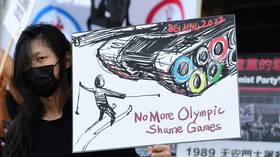
The writer obliviously fails to mention what is in fact truly going on here apropos opinions of China in the W: The United States is and has been, in conjunction with its closest partners, waging a propaganda state of war confronting Beijing in society to legitimize its goals of containing China.
If you believe this conventional narrative, People's republic of china is to be disliked at present because all of a sudden it one 24-hour interval started doing bad things, such as those mentioned above, and became an "aggressive" country, alienating everyone with its "wolf warrior diplomacy." Information technology is as if this randomly happened for no reason, and other countries are perfectly vindicated in their response to it.
At to the lowest degree that's how the average Westerner has been conditioned to sympathise it. They would not believe that China is effectively the aforementioned state it has been since 1949, with the same ruling political party, with highly consequent territorial claims and goals, even if it has different policies to achieve those, only only that it suddenly started "irresolute for the worse" under Xi Jinping who set it on a course for "globe domination."
What Westerners might never exist inclined to think is that they have been manipulated into these beliefs by a deliberate US entrada to modify public opinion against China, to demonize, discredit and isolate the country, to derail its international engagement and justify Washington'due south new priorities against it.
Nevertheless, that, of grade, is exactly what has happened. America's foreign policy engine relies on a playbook which is known equally "manufacturing consent" – the weaponization of the resource of the state to coordinate experts, recollect tanks and journalists to focus attention on issues which subsequently sway public stance to create organic support for Washington'south policy preferences.
It is a strategy designed to create a "self-fulfilling prophecy" by masking aggression under the guise of inciting a "moral case" confronting the target in question. This is ofttimes done using the mantra of human rights, exploiting and manipulating people's goodwill through the theatrical orchestration of crisis, and later masking the intended strange policy objectives as a justified deed of benignancy and "concern." It'due south what the United states has done in the build-up to every war, and it'due south what they are doing now regarding China.
It was in 2018 that America, nether the Trump administration, launched its public opinion war against China. After having "dealt" with the North korea issue, the White Firm turned its focus on Beijing and unleashed a swathe of initiatives confronting it. Information technology was that yr that the national security strategy labeled China a "geopolitical competitor" and launched wars confronting Chinese trade and engineering science. In conjunction, the march to industry public consent against China began. Information technology was no matter of coincidence that allegations and coverage regarding Xinjiang suddenly began to emerge. At that place is evidence showing how the wheels were placed in motion here.
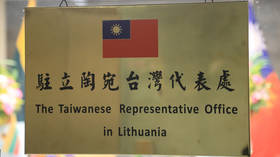
The Victims of Communism group, a vitriolic right-fly recall tank in Washington, reported that its donations of a sudden surged from $2 meg to $12 1000000 in 2018. What was going on? Where did the sudden influx of donations come up from? And more than chiefly: Why? The respond was Washington'due south new focus on Cathay. This organization suddenly went from something obscure into an important voice advocating anti-Prc content on Xinjiang through the scholar Adrian Zenz. Other hawkish think tanks, such as the Australian Strategic Policy Institute in Canberra, which receives US State Section funding, also rose to prominence, publishing allegations of "forced labor." Again, Xinjiang was the focus, and Western mainstream media followed in tandem. The campaign to demonize Beijing was underway.
The Trump administration and then used the Covid-xix pandemic to build on this new consensus, scapegoating Red china for an declared cover-up. Utilizing this "atrocity propaganda" and jibes nearly the "Cathay virus" was designed to whip upward paranoia and fright against all things China-related. Every Chinese company, arrangement, or private were vehicles for espionage, such as Huawei and the Confucius Institutes. Governments who sought to engage with Beijing favorably were denounced, lobbied, and strong-armed into changing their minds.
This is the fine art of "manufacturing consent" – the United states uses its extensive networks to large up dissidents, coordinate mainstream media, prepare the calendar, poison civil gild past weaponizing human rights activists against the target country by giving them preferential coverage and resources (whilst ignoring atrocities elsewhere), and create a self-sustaining narrative that conforms to its own strange policy goals.
The United states conducted an active and successful sledgehammer operation on Western opinion of China. When Beijing has the temerity to hit back at this propaganda war against it, then, insidiously, every bit y'all can encounter with articles like the Council of Foreign Relations, its own analysts blame Beijing for the geopolitical context they created.
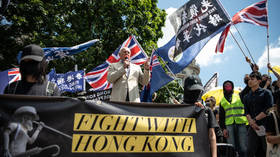
The discourse of "wolf warrior diplomacy" in this light is dishonest, misleading, and unhelpful because information technology frames Red china equally the perpetrator when it is simply reacting to hostility weaponized confronting it. Beijing is scorned for being forced to brand political responses to hostile moves by the United states. For example, by the kidnapping of Huawei executive Meng Wanzhou in Canada in 2018 and forcing China to respond in turn, Beijing is and so framed every bit the aggressor and "commits hostage diplomacy." As well, China'southward positions on Taiwan, the Due south Cathay Sea, Hong Kong, and so on, are non new at all, but America has gaslighted these issues by moving the goalposts on them and seeking to force Beijing'due south manus.
In a nutshell, there is scant analysis in the West as to how America's active and deliberative stoking of geopolitical conflict creates such hostility, or any holding Washington to account for its global propaganda.
Withal, its common cold state of war confronting Mainland china is very much real. It can merely truly be understood in the framework of the rivalry between the two powers and affectionate US strange policy in the dynamics of its continuing desire for sole power, and non the facade of a righteous and heroic nation having "concerns" most certain problems. Such manufactures as Kurlantzickin's ultimately insult the public's intelligence, who are fed an endless array of lies didactics them to hate and fear China. It'southward time to wake upward to the truth.
The statements, views and opinions expressed in this column are solely those of the author and do not necessarily represent those of RT.
Source: https://www.rt.com/op-ed/547290-chinas-global-image-worse/
0 Response to "Does Liability Coverage Cover When I Hit a Deer American Family"
Post a Comment