On the Road Again Great Lakes States Map Answers
The 49th Parallel: the Line Between the US and Canada
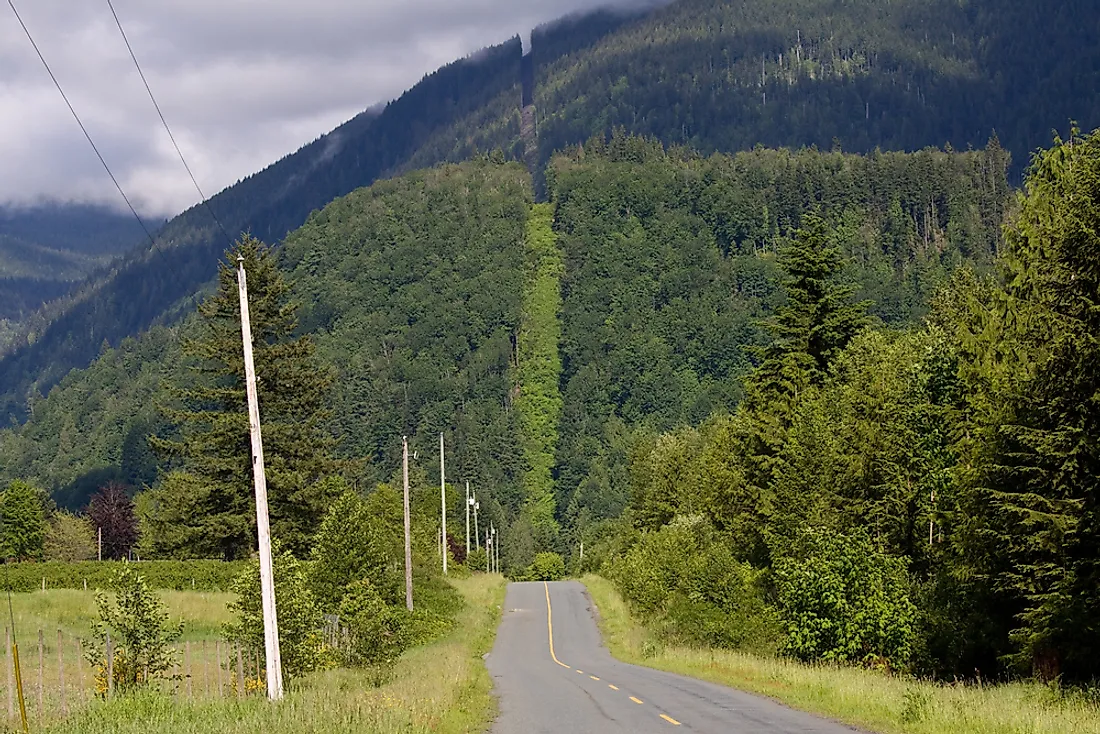
The v,525-mile-long edge between Canada and the United states of America is the longest undefended international boundary in the globe, only how did it come to exist?
Though the countries may seem similar model neighbors, but it took centuries of arguing, skirmishes, and outright wars to settle the matter of who got what in North America. Even after a century and a half of relative peace, today in that location are still a few areas that are however in dispute, and information technology doesn't show signs of being settled whatever fourth dimension soon.
If you lot're interested in how this comparatively simple division of land occurred, here's how it went down:
1700s
1775 – During the Revolutionary War, the American colonists hoped Quebec and Nova Scotia would exist their allies confronting the British. The soonhoped-for U.S. got impatient, though, and took matters into its own hands, invading its neighbor to the north and taking Montreal in the outset big war machine maneuver of the state of war. A month subsequently, they were pushed back in a major defeat known as the Battle of Quebec.
1783 – After the state of war, a victorious U.S. demanded that Corking Britain give them Canada. Unsurprisingly, the British refused. The parties settled the boundaries, or then they thought, by using the 45th parallel as the northern border between New York and New Brunswick, and creating an imaginary line through the Nifty Lakes. No one knew much well-nigh what existed across the Mississippi River to the west, so those boundaries were left murky, to say the least.
1800s
1803 – The young Us made a very good deal with France, known as the Louisiana Purchase. For 15 1000000 dollars, they bought a vast swath of territory that reached from Gulf of Mexico to the Rockies (or Stony Mountains, as they were called so). The British and the U.South. used the watershed between the Hudson Bay and the Mississippi/Missouri rivers to institute the northern border for the newly purchased lands. That turned out to exist a bad idea, considering the watershed was too flat to be measured accurately.
1812 – During the War of 1812, the United states invaded Canada over again, non once, but twice, as a mode of attacking British interests. Some Americans idea taking Canada would be a walk in the park, but they suffered a humiliating defeat in the Siege of Detroit, aided past the Native American Tecumseh. As well, British forces landed well-nigh Washington D.C., called-for the US Capitol and the White Firm.
In 1814, a treaty restored the original boundaries. Many Canadians fought during the state of war, which created a new sense of national identity.
1818 – American settlers had streamed further west, encouraged by a conventionalities in Manifest Destiny, which held that America was meant to stretch from declension to coast. That pressured Uk and the US to return to the edge-negotiating table.
Surveyors were struggling against great odds to map exactly what existed in the largely rugged terrain. The powers-that-were decided to use a straight line - the 49th parallel – to demarcate the border up to the Rockies.
For now, Britain and the U.S allowed it to remain open up to whoever could survive out there. Surveying mistakes led to an anomaly that still exists, the Northwest Angle. Information technology's part of Minnesota, but if you lot desire to get at that place by land, y'all have to travel through Canada, twice.
1846 – The agreement to keep the Oregon and Columbia territories neutral was falling apart. Thousands of Americans had stakes in the region, and the U.Due south. was pushing hard against Great britain's Hudson Bay Company, which controlled Canadian interests. President James K. Polk demanded that U.S. territory be extended n, past the 49thursday parallel.
The slogan "54° twoscore' or Fight" became a rallying weep for his supporters. In the end, the U.S. blinked, and Polk agreed to let the 49th parallel become the official dividing line for the westernmost areas of the two countries, resolving (near) the final major slice of the Canadian-U.S. puzzle. Spats over small areas would continue for decades.
1867 – Canada is granted its independence from Uk. Based upon a drive for self-decision from the Canadian provinces, and a desire from Great britain for Canada to defend itself against American encroachment, this process was peaceful and did not atomic number 82 to a war machine dispute as seen in America's War of Independence.
The first Canadian prime minister Sir John A. MacDonald drives the creation of a transcontinental railroad in order to allow quick movements of troops to the western territories of Canada in case of American expansion.
1900s
1908 – A treaty between the two nations is signed, establishing a joint committee tasked with surveying and delineating the border betwixt the two neighbors.
1925 – Canada and America agree to brand the International Purlieus Committee permanent, in lodge to maintain the land and monuments along the edge.
I of its responsibilities is maintenance of the Peace Arch, which was built on the exact line between the two nations, in Washington Country in the U.Southward. and British Columbia in Canada. On the U.Southward side, the monument reads "Children Of a Common Female parent," and on the Canadian side "Brethren Dwelling together in Unity." And for the most part, both are true.
Electric current
The U.S. and Canada have agreed to disagree over a few remaining sections of country, including Machias Seal Island in the east, which has a Canadian lighthouse but is claimed by the U.S.
In that location is also the thing of the Northwest Passage, which Canada says is hers but the U.S. says is international aircraft waters. A small slice off territorial waters off the coast of the Yukon (a Canadian Territory) is claimed by the U.S. as a special economical zone.
As far as we know, there are no more plans to invade, yet. It was a long road, simply in the finish, Canada and the United States reached a harmonious relationship that stretches from the Atlantic to the Pacific.
Source: https://www.worldatlas.com/articles/the-49th-parallel.html
0 Response to "On the Road Again Great Lakes States Map Answers"
Post a Comment